
Fibres, Yarns and Material Compositions
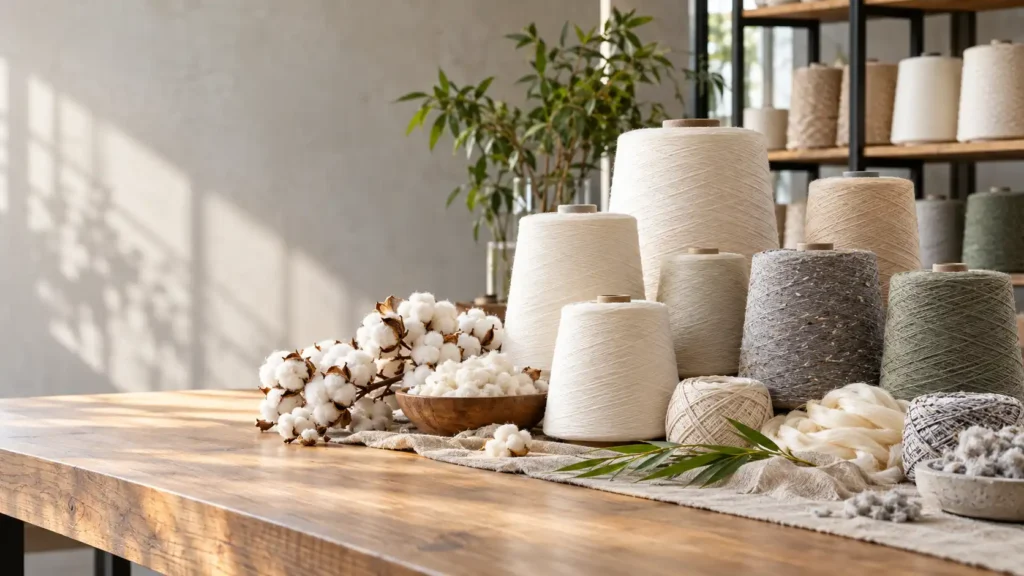
Apparel Yarn Sourcing, Premium Cotton, Regenerated Cellulosic Fibres, Recycled Materials, Melange and Fancy Yarns in Tiruppur, India
Mirthuni Apparel Sourcing Service provides apparel yarn sourcing, fibre selection, material composition development and speciality yarn procurement support for international apparel brands, retailers, importers and private-label clothing businesses.
Based in Tiruppur, Tamil Nadu, India, we coordinate sourcing through selected spinning mills, yarn manufacturers, fibre suppliers, textile distributors and apparel manufacturing partners.
Our sourcing capabilities cover conventional cotton, combed cotton, compact-spun cotton, organic cotton, recycled cotton, recognised international cotton sourcing programmes, modal, lyocell, bamboo viscose, conventional and recycled polyester, and a wide range of blended yarn compositions.
We also evaluate speciality yarn requirements, including melange (mélange), marl, marled, heather, neppy, slub, injected slub, grindle, twisted and multi-ply yarns.
For premium and programme-specific requirements, we can evaluate eligible sourcing involving Supima cotton, COTTON USA, Australian cotton, Cotton made in Africa, Better Cotton, TENCEL Modal, TENCEL Lyocell and LENZING ECOVERO viscose.
Our role is to help buyers identify suitable fibres, yarn specifications, compositions and sourcing arrangements before proceeding to fabric development, sampling and bulk apparel manufacturing.
All materials are subject to yarn availability, technical feasibility, commercial volume, supplier confirmation and applicable documentation.
1. Apparel Fibre and Yarn Sourcing Services
The selection of fibres and yarns is a fundamental stage of apparel development.
Fibre characteristics, yarn quality, spinning technology, blend ratios and speciality effects influence the appearance, comfort, drape, durability and manufacturing suitability of a finished garment.
Mirthuni Apparel coordinates yarn sourcing and material development based on buyer specifications.
Our services include:
Conventional and premium cotton yarn sourcing
Carded, combed and compact-spun yarn selection
Organic cotton sourcing
Cotton origin and sustainability programme sourcing
Recycled cotton and recycled polyester yarn sourcing
Modal, lyocell, viscose and bamboo viscose yarn sourcing
Branded fibre sourcing evaluation
Cotton-polyester and cotton-modal blended yarns
Cotton-lyocell and bamboo-cotton blended yarns
Two-component and three-component yarn compositions
Melange, marl and heather yarn sourcing
Neppy, slub, injected slub and grindle yarn sourcing
Twisted and multi-ply yarn development
Yarn-dyed and speciality colour sourcing
Yarn count and spinning specification selection
Material traceability and certification review
Custom yarn sampling and procurement coordination
The final yarn selection depends on the intended garment, technical specifications, supplier capabilities and production volume.
2. Understanding Fibre, Yarn and Finished Fabric Composition
A fibre is the raw material used to manufacture yarn.
Yarn is formed by spinning fibres or assembling suitable filaments into a continuous textile material.
A finished fabric may contain one fibre type or a combination of different fibres.
Examples include:
100% cotton
60% cotton / 40% polyester
50% cotton / 50% modal
70% bamboo viscose / 30% cotton
60% cotton / 35% modal / 5% elastane
It is important to distinguish between yarn composition and finished fabric composition.
For example, a fabric containing 60% cotton and 40% polyester may be produced using a blended yarn or a combination of separate cotton and polyester yarns.
Similarly, elastane may be introduced through a suitable knitting system rather than being incorporated into the primary spun yarn.
Our yarn sourcing process considers:
Fibre composition
Fibre origin
Spinning method
Yarn count
Yarn construction
Colour and speciality effects
Supplier documentation
Finished material requirements
Knitting structures, plating arrangements, GSM and finished fabric construction are covered separately on our Knitting and Knitted Fabric Development page.
Mirthuni Apparel provides apparel yarn sourcing support for international clothing brands seeking conventional cotton, premium cotton, regenerated cellulosic fibres, recycled yarns and custom blended compositions.
Our apparel yarn sourcing services include melange, marl, heather, slub, neppy and other speciality yarn developments through selected spinning mills and yarn suppliers.
For custom apparel yarn sourcing enquiries, buyers can share their required fibre composition, yarn count, colour, speciality yarn effect and expected production quantity.
3. Conventional Cotton Yarn
Cotton is one of the principal fibres used in knitted apparel.
It is widely selected for T-shirts, polo shirts, sweatshirts, hoodies, joggers, knitted shorts, loungewear, sleepwear and children’s garments.
We can evaluate cotton yarns produced using different preparation and spinning methods.
3.1 Carded Cotton
Carded cotton yarn is produced through conventional cotton fibre preparation and spinning.
It may be considered for suitable casualwear developments where the buyer’s required handfeel, surface appearance and price parameters can be achieved.
3.2 Combed Cotton
Combed cotton undergoes additional fibre preparation intended to remove a portion of shorter fibres and improve yarn uniformity.
It is commonly selected for premium apparel requiring a smoother surface and more consistent appearance.
3.3 Compact-Spun Cotton
Compact spinning is a yarn manufacturing process designed to improve fibre integration and reduce yarn hairiness.
Compact cotton yarn may be considered for premium apparel developments requiring a cleaner yarn surface.
3.4 Ring-Spun Cotton
Ring spinning is widely used to manufacture apparel yarns.
Ring-spun cotton may be available in carded, combed and compact-spun specifications depending on the supplier and spinning process.
3.5 Open-End Cotton
Open-end, or rotor-spun, cotton yarn may be evaluated for selected casualwear applications.
Its properties differ from ring-spun yarn and should be assessed against the intended garment requirements.
4. Organic Cotton and GOTS Sourcing
Organic cotton may be considered for buyers requiring organic fibre content and supporting supply-chain documentation.
Mirthuni Apparel can evaluate organic cotton yarn from suitable suppliers according to the required yarn count, composition and commercial volume.
Where requested, sourcing may involve suppliers participating in the Global Organic Textile Standard (GOTS) certification system.
A finished garment cannot automatically be described as GOTS-certified merely because organic cotton was used.
Any GOTS product claim requires appropriate certification and transaction documentation covering the relevant supply-chain stages and finished product.
Organic cotton availability and minimum quantities are confirmed for each project.
5. Better Cotton — Formerly Associated with BCI
Better Cotton is an international cotton sustainability programme historically associated with the Better Cotton Initiative (BCI).
We can evaluate Better Cotton-related sourcing through suitable participating suppliers where available.
Buyers should distinguish between programme-based cotton sourcing, physical traceability and finished-product claims.
Mass-balance sourcing does not automatically establish that a particular garment physically contains traceable Better Cotton.
Applicable sourcing and marketing claims must comply with the relevant Better Cotton programme requirements.
6. Supima Cotton
Supima is a recognised brand associated with American-grown extra-long-staple Pima cotton.
Supima yarn may be considered for premium T-shirts, polo shirts and other selected high-quality knitted garments.
Sourcing depends on yarn count, supplier availability, order volume and supporting documentation.
Use of the Supima name, logo and related product claims requires appropriate verification and applicable brand authorisation.
7. U.S. Cotton and COTTON USA
U.S.-origin cotton may be considered for buyers requesting specific cotton origins.
COTTON USA is a trademark associated with Cotton Council International.
Depending on eligible yarn supply, we can evaluate U.S.-origin cotton and COTTON USA-related sourcing requirements.
The origin of cotton fibre, the origin of yarn manufacturing and eligibility to use a promotional trademark are distinct matters.
Any origin or trademark claim must be appropriately documented.
8. Australian Cotton
Australian-grown cotton may be evaluated for selected apparel yarn sourcing programmes.
Availability depends on suitable yarn counts, spinning arrangements, supply channels and commercial quantities.
Australian cotton origin claims require appropriate supplier documentation.
9. Cotton made in Africa (CmiA)
Cotton made in Africa (CmiA) is a recognised cotton sustainability standard and sourcing programme.
We can evaluate CmiA-associated sourcing through suitable participating suppliers, subject to yarn availability and programme requirements.
Any CmiA-related traceability or marketing claim must comply with the applicable sourcing and trademark rules.
10. Recycled Cotton Yarn
Recycled cotton may be produced from suitable pre-consumer or post-consumer textile materials.
It may be blended with virgin cotton, polyester or other compatible fibres according to the required yarn characteristics.
Potential applications include casual T-shirts, sweatshirts, hoodies, joggers and selected knitted garments.
Recycled cotton yarn characteristics depend on recovered fibre length, fibre quality, blend composition and spinning technology.
We can evaluate recycled cotton sourcing associated with the Global Recycled Standard (GRS) or Recycled Claim Standard (RCS) where required.
Certification and recycled-content claims require valid documentation for the relevant supply chain and product.
11. Premium Cotton Origins and Sourcing Programmes
Buyers may request different cotton origins, branded cotton fibres or recognised sourcing programmes.
| Cotton category | Sourcing consideration |
|---|---|
| Conventional cotton | Standard apparel yarn |
| Combed cotton | Premium yarn preparation |
| Compact-spun cotton | Cleaner yarn surface |
| Organic cotton | Organic fibre requirements |
| Supima cotton | Branded extra-long-staple cotton |
| U.S.-origin cotton | Specified fibre origin |
| COTTON USA | Eligible programme and trademark requirements |
| Australian cotton | Specified fibre origin |
| Better Cotton | Programme-specific sourcing |
| Cotton made in Africa | Programme-specific sourcing |
| Recycled cotton | Recycled-content requirements |
These categories do not represent interchangeable certifications.
Availability is subject to yarn count, supplier arrangements, documentation and order volume.
Mirthuni Apparel provides apparel yarn sourcing support for international clothing brands seeking conventional cotton, premium cotton, regenerated cellulosic fibres, recycled yarns and custom blended compositions.
Our apparel yarn sourcing services include melange, marl, heather, slub, neppy and other speciality yarn developments through selected spinning mills and yarn suppliers.
For custom apparel yarn sourcing enquiries, buyers can share their required fibre composition, yarn count, colour, speciality yarn effect and expected production quantity.
12. Regenerated Cellulosic Fibres
Regenerated cellulosic fibres are produced by processing cellulose obtained from suitable plant-based raw materials.
They may be selected for soft, drapable knitted apparel and premium casualwear.
Our sourcing scope includes modal, lyocell, viscose, bamboo viscose and eligible branded regenerated cellulosic fibres.
13. Modal Yarn
Modal is a regenerated cellulosic fibre commonly used in soft and drapable textile materials.
It may be considered for premium T-shirts, loungewear, sleepwear, soft-touch tops and selected innerwear.
Modal may be sourced alone or in suitable blends with cotton and other compatible fibres.
14. LENZING Modal and TENCEL Modal
Lenzing manufactures regenerated cellulosic fibres, including modal.
TENCEL Modal is a branded fibre offering from Lenzing AG.
We can evaluate genuine eligible TENCEL Modal yarn sourcing according to buyer specifications, yarn count, composition and commercial volume.
Generic modal should not automatically be described as TENCEL Modal or LENZING-produced modal.
Branded fibre claims require appropriate sourcing evidence and compliance with applicable trademark guidelines.
15. Lyocell Yarn
Lyocell is a regenerated cellulosic fibre manufactured using a solvent-spinning process.
It may be considered for soft knitted apparel and selected premium material developments.
Lyocell can be evaluated alone or in suitable blends with cotton, modal and other compatible fibres.
16. LENZING Lyocell and TENCEL Lyocell
Lenzing manufactures lyocell fibres, including eligible fibres marketed under the TENCEL brand.
TENCEL Lyocell may be considered for premium T-shirts, casual knitted tops, loungewear and selected cotton-lyocell blended materials.
Availability depends on eligible suppliers, yarn specifications and order quantities.
TENCEL branding and related claims require appropriate verification.
17. LENZING ECOVERO Viscose
LENZING ECOVERO is a branded viscose fibre offering from Lenzing.
It may be considered for suitable yarn and blended material developments where eligible supply is available.
Branded fibre sourcing and environmental claims require appropriate documentation and compliance with relevant brand requirements.
18. Conventional Viscose
Conventional viscose is a regenerated cellulosic fibre that may be used in soft and drapable apparel materials.
Viscose, modal and lyocell are distinct fibre categories and should be identified accurately in technical specifications.
19. Bamboo Viscose
Bamboo viscose is a regenerated cellulosic fibre produced using bamboo-derived cellulose.
It may be considered for selected soft knitted apparel developments.
Potential combinations include:
Bamboo viscose and cotton
Bamboo viscose and modal
Bamboo viscose and elastane
Bamboo viscose, cotton and elastane
Bamboo viscose should not automatically be described as organic bamboo, natural bamboo fibre or inherently antibacterial without appropriate substantiation.
20. Conventional Polyester Yarn
Polyester is a synthetic fibre used in various apparel yarns and blends.
For approved casualwear categories, we can evaluate polyester-containing yarns for sweatshirts, hoodies, joggers and other suitable knitted garments.
Our sourcing focus does not include technical polyester performance activewear.
21. Recycled Polyester Yarn
Recycled polyester may be considered for selected casualwear and blended yarn developments.
Potential combinations include recycled polyester with cotton, recycled cotton or other suitable fibres.
GRS- or RCS-related sourcing may be evaluated where required.
The presence of recycled polyester does not automatically mean that the finished product is certified.
22. Two-Component Blended Yarn Compositions
Two-component blended yarns combine two fibre types within a specified yarn composition.
The following are illustrative sourcing and development options.
| Yarn composition | Potential application |
|---|---|
| 80% cotton / 20% polyester | Sweatshirts, casualwear |
| 70% cotton / 30% polyester | Casualwear |
| 65% cotton / 35% polyester | Blended apparel |
| 60% cotton / 40% polyester | Sweatshirts, fleece |
| 50% cotton / 50% polyester | Casual knitted garments |
| 50% cotton / 50% modal | Soft-touch T-shirts |
| 60% cotton / 40% modal | Premium casualwear |
| 70% cotton / 30% modal | Soft knitted tops |
| 50% cotton / 50% lyocell | Premium apparel |
| 60% cotton / 40% lyocell | Soft-touch apparel |
| 70% cotton / 30% lyocell | Casualwear |
| 50% cotton / 50% bamboo viscose | Loungewear |
| 60% bamboo viscose / 40% cotton | Soft casualwear |
| 70% bamboo viscose / 30% cotton | Premium soft-touch garments |
| 50% cotton / 50% viscose | Drapable apparel |
| 50% modal / 50% lyocell | Selected premium materials |
These compositions are subject to spinning feasibility, available yarn counts and minimum procurement quantities.
23. Recycled Fibre Blended Yarns
Recycled fibres may be blended with virgin fibres to achieve selected yarn characteristics.
| Yarn composition | Development consideration |
|---|---|
| 30% recycled cotton / 70% virgin cotton | Cotton-rich recycled blend |
| 50% recycled cotton / 50% virgin cotton | Recycled cotton blend |
| 30% recycled cotton / 70% polyester | Mixed recycled cotton blend |
| 50% recycled cotton / 50% recycled polyester | Recycled-content casualwear yarn |
| 60% cotton / 40% recycled polyester | Cotton-rich recycled polyester blend |
| 80% cotton / 20% recycled polyester | Casualwear |
| 50% recycled polyester / 50% cotton | Mixed fibre yarn |
| 65% recycled polyester / 35% cotton | Polyester-rich casualwear yarn |
Higher recycled cotton percentages may require specialised spinning arrangements or blending adjustments.
Any certification claim requires appropriate verification.
24. Three-Component and Multi-Fibre Yarn Compositions
Selected developments may require three-component or multi-fibre yarn compositions.
| Proposed yarn composition | Potential application |
|---|---|
| 50% cotton / 30% modal / 20% polyester | Soft casualwear |
| 60% cotton / 20% modal / 20% polyester | Cotton-rich casualwear |
| 50% cotton / 30% lyocell / 20% polyester | Premium blended yarn |
| 50% cotton / 30% bamboo viscose / 20% polyester | Soft-touch casualwear |
| 40% cotton / 40% modal / 20% lyocell | Premium material development |
| 40% cotton / 30% modal / 30% lyocell | Soft blended yarn |
| 50% cotton / 25% modal / 25% lyocell | Premium apparel yarn |
| 40% recycled cotton / 30% virgin cotton / 30% recycled polyester | Recycled-content yarn |
| 50% cotton / 25% recycled cotton / 25% recycled polyester | Mixed recycled-content yarn |
These are potential development compositions rather than confirmed stock items.
25. Elastane and Spandex Material Development
Spandex, also known as elastane, is an elastic synthetic fibre used to provide stretch and recovery in suitable textile constructions.
For custom stretch fabric development, we can evaluate approximately 3% to 10% elastane in the finished fabric composition, depending on technical feasibility.
The appropriate percentage depends on:
Main fibre composition
Yarn specifications
Knitting construction
Target GSM
Required garment fit
Stretch and recovery
Dyeing and finishing
Dimensional stability
Elastane may be introduced through suitable yarn or knitting systems rather than being incorporated into the primary blended spun yarn.
Illustrative finished fabric compositions include:
| Finished fabric composition | Potential application |
|---|---|
| 97% cotton / 3% elastane | Light-stretch tops |
| 95% cotton / 5% elastane | Stretch T-shirts |
| 92% cotton / 8% elastane | Fitted tops |
| 90% cotton / 10% elastane | Selected higher-stretch garments |
| 95% modal / 5% elastane | Soft stretch garments |
| 92% modal / 8% elastane | Fitted soft-touch garments |
| 95% lyocell / 5% elastane | Premium stretch tops |
| 92% bamboo viscose / 8% elastane | Stretch loungewear |
| 67.5% bamboo viscose / 27.5% cotton / 5% elastane | Three-fibre stretch fabric |
| 60% cotton / 35% modal / 5% elastane | Cotton-modal stretch fabric |
| 60% cotton / 35% lyocell / 5% elastane | Cotton-lyocell stretch fabric |
| 60% cotton / 35% polyester / 5% elastane | Stretch casualwear |
Not every elastane percentage is suitable for every fabric construction, GSM or finishing process.
26. Yarn Counts and Spinning Specifications
Yarn count describes yarn fineness using an applicable measurement system.
Cotton yarns are commonly specified using the English cotton count system, Ne.
Depending on buyer requirements and supplier availability, yarn counts may include:
20s
24s
26s
30s
34s
40s
Other counts may be evaluated.
Yarn sourcing also considers fibre quality, spinning method, strength, evenness, hairiness, twist and blend consistency.
Mirthuni Apparel provides apparel yarn sourcing support for international clothing brands seeking conventional cotton, premium cotton, regenerated cellulosic fibres, recycled yarns and custom blended compositions.
Our apparel yarn sourcing services include melange, marl, heather, slub, neppy and other speciality yarn developments through selected spinning mills and yarn suppliers.
For custom apparel yarn sourcing enquiries, buyers can share their required fibre composition, yarn count, colour, speciality yarn effect and expected production quantity.
27. Melange, Marl and Heather Yarn Sourcing
Melange, marl and heather yarns are widely requested for casualwear, T-shirts, sweatshirts, hoodies, joggers and fashion knitted garments.
These yarns create mixed-colour appearances that differ from conventional solid-colour yarns.
International buyers may use the terms melange, mélange, marl, marled, heather or heathered when describing similar visual effects.
However, these terms are not always technically interchangeable.
27.1 Melange Yarn
Melange yarn generally refers to yarn with a blended or mixed-colour appearance, commonly produced using differently coloured fibres.
Available developments may include cotton melange, cotton-viscose melange and cotton-polyester melange.
27.2 Marl and Marled Yarn
Marl or marled yarn commonly refers to a mixed-colour effect produced by combining differently coloured yarn components, often through twisting or plying.
The precise construction depends on the supplier and yarn specification.
27.3 Heather and Heathered Yarn
Heather is a widely used commercial term for a subtle mixed-colour appearance.
Buyers may request heather grey, charcoal heather, coloured heather or other mixed-shade effects.
A heather appearance does not establish a particular fibre composition or spinning process.
27.4 Common International Buyer Terminology
| Buyer terminology | Typical description |
|---|---|
| Grey melange | Mixed grey appearance |
| Grey marl | Grey mixed-colour effect |
| Heather grey | Commercial description for mixed grey |
| Ecru melange | Natural cream or beige mixed shade |
| Ecru marl | Cream or beige marled effect |
| Charcoal melange | Dark grey mixed shade |
| Charcoal marl | Dark grey marled effect |
| Coloured melange | Mixed-colour yarn |
| Coloured marl | Contrasting-colour yarn effect |
| Marled cotton yarn | Cotton yarn with marled appearance |
| Cotton-polyester heather | Heather-effect cotton-polyester yarn |
| Cotton-viscose melange | Melange-effect cotton-viscose blend |
The intended yarn construction should be confirmed using a reference sample or detailed specification.
28. Cotton Melange Yarn
Cotton melange yarn is commonly used for T-shirts, sweatshirts, hoodies and other casual knitted garments.
Potential shades include:
Light grey melange
Medium grey melange
Dark grey melange
Ecru melange
Natural-look melange
Custom coloured melange
Grey melange and ecru melange are commonly available as ready-stock options through selected yarn suppliers.
However, stock availability depends on the yarn count, composition, shade and required quantity.
Custom shades may require made-to-order yarn production.
29. Cotton-Viscose Melange Yarn
Cotton-viscose melange yarn combines cotton and viscose fibres to create a soft yarn with a mixed-colour appearance.
It may be considered for:
Premium T-shirts
Soft-touch casualwear
Loungewear
Fashion knitted tops
The cotton-viscose blend ratio and melange shade depend on the selected supplier and yarn development requirements.
Stock and custom options may be evaluated according to availability.
30. Cotton-Polyester Melange Yarn
Cotton-polyester melange yarn combines cotton and polyester fibres to create selected mixed-colour effects.
Potential applications include:
T-shirts
Sweatshirts
Hoodies
Joggers
Casual knitted garments
Common buyer requests may include grey melange, heather grey, charcoal melange, ecru melange and coloured heather effects.
Selected standard shades may be available from stock.
Custom colours and non-standard compositions may require order-based spinning or colour development.
31. Melange and Marl Shade Availability
Mirthuni Apparel can evaluate ready-stock and custom-developed melange or marl yarns.
| Yarn or shade | General availability |
|---|---|
| Grey melange cotton | Common stock-supported option |
| Ecru melange cotton | Common stock-supported option |
| Grey marl | Stock-dependent on construction |
| Heather grey | Common commercial shade, stock-dependent |
| Charcoal melange | Supplier-dependent |
| Cotton-viscose melange | Blend and shade dependent |
| Cotton-polyester melange | Blend and shade dependent |
| Custom coloured melange | Generally made to order |
| Custom coloured marl | Generally made to order |
| Speciality heather effects | Supplier-dependent |
Ready-stock means a sourcing option commonly held by selected suppliers, not a guarantee of immediate availability.
Final stock confirmation is required for the exact yarn count, composition, colour and quantity.
32. Neppy Yarn and Coloured Nep Effects
Neppy yarn contains intentionally visible fibre clusters or neps that create a decorative speckled appearance.
Depending on the yarn development, the effect may include:
White neps
Black neps
Coloured neps
Multicolour neps
Tonal nep effects
Contrasting speckled effects
Neppy yarn may be considered for fashion T-shirts, textured casualwear and selected premium knitted garments.
Nep size, distribution and colour depend on the spinning process and supplier capability.
33. Slub Yarn
Slub yarn contains intentional variations in yarn thickness.
These variations create an irregular textured appearance.
Slub yarn may be produced using cotton or suitable blended fibres.
It may be considered for fashion T-shirts, casual tops and selected textured garments.
The required slub frequency, thickness variation and appearance should be confirmed using an approved yarn or fabric reference.
34. Injected Slub Yarn
Injected slub yarn is a speciality effect yarn associated with irregular colour or texture variations.
Depending on the supplier’s technology, the yarn may contain contrasting fibres, coloured effects or intentionally introduced slub characteristics.
Potential options include:
Tonal injected effects
Contrasting colour injections
Irregular slub effects
Selected multicolour appearances
The term injected slub may describe different mill-specific constructions.
Technical specifications should therefore be confirmed through supplier samples before production.
35. Twisted and Multi-Ply Yarns
Twisted and multi-ply yarns may be used where a particular yarn construction or appearance is required.
Potential options include:
Two-ply yarns
Multi-ply yarns
Custom twist levels
Contrasting-colour twisted yarns
Multi-colour ply combinations
Selected twist-effect yarns
Yarn twist, ply construction and component colours influence the resulting appearance and yarn characteristics.
Marl effects may also be produced through suitable combinations of differently coloured yarn components.
36. Grindle Yarn
Grindle yarn is a speciality yarn associated with mixed-colour or irregular visual effects.
Depending on the spinning technology, grindle yarn may be developed using contrasting fibres or yarn components.
It may be considered for casual T-shirts, fashion tops and selected textured knitted garments.
Because commercial descriptions vary between suppliers, the required grindle appearance should be confirmed against actual yarn or fabric references.
37. Other Fancy and Speciality Yarns
Depending on buyer requirements, we can evaluate additional fancy yarn developments, including:
Heather-effect yarns
Marl-effect yarns
Multi-colour twisted yarns
Two-tone yarns
Neppy yarns
Irregular-effect yarns
Selected textured yarns
Custom fashion yarns
All speciality yarns are subject to fibre composition, yarn count, spinning feasibility, supplier availability and minimum procurement quantities.
38. Ready-Stock and Made-to-Order Yarn Sourcing
Different yarn categories have different procurement requirements.
| Yarn category | Typical sourcing arrangement |
|---|---|
| Conventional cotton | Standard supplier availability |
| Combed cotton | Standard supplier availability |
| Compact cotton | Supplier-dependent |
| Organic cotton | Certified supply-chain availability |
| Premium branded cotton | Order and supplier dependent |
| Modal and lyocell | Yarn count and supplier dependent |
| TENCEL branded fibres | Eligible supplier and volume dependent |
| Recycled cotton | Supplier and blend dependent |
| Recycled polyester | Supplier and blend dependent |
| Grey melange | Common stock-supported shades |
| Ecru melange | Common stock-supported shades |
| Custom coloured melange | Generally order-based |
| Custom marl yarn | Construction and order dependent |
| Neppy yarn | Stock or custom development |
| Slub yarn | Selected stock or custom development |
| Injected slub yarn | Generally order-based |
| Twisted yarn | Standard or custom development |
| Grindle yarn | Supplier-dependent |
| Custom three-component blend | Generally subject to spinning minimums |
Actual stock, prices, minimum quantities and production lead times must be confirmed before commercial commitment.
39. Yarn-Dyed and Custom Colour Yarn Sourcing
Selected apparel developments require yarn colours to be established before knitting.
We can coordinate sourcing enquiries involving:
Solid yarn-dyed cotton
Yarn-dyed blended yarn
Melange shade development
Custom marl effects
Multi-colour yarn combinations
Speciality colour-effect yarns
Buyer-approved shade references
Yarn-dyed developments may require minimum dyeing quantities, colour approval and additional preparation.
The subsequent knitting of feeder stripes, engineered stripes and yarn-dyed jacquard patterns is covered separately on our Knitting and Knitted Fabric Development page.
40. Yarn Sampling and Speciality Effect Approval
Custom yarn sourcing may require physical sample approval before bulk procurement.
Depending on the project, buyers may need to approve:
Fibre composition
Yarn count
Yarn construction
Melange shade
Marl appearance
Heather effect
Nep colour and distribution
Slub appearance
Injected colour effects
Twist and ply specifications
Recycled-content documentation
Branded fibre documentation
Sampling and development costs are confirmed according to the project scope.
41. Branded Fibre and Certification Verification
Material sourcing programmes may involve different verification requirements.
These may include:
Fibre-origin documentation
Branded fibre authenticity
Supplier programme participation
Organic certification
Recycled-content certification
Chain-of-custody documentation
Transaction certificates
Product claim eligibility
Trademark authorisation
Relevant programmes and brands may include GOTS, Better Cotton, Supima, COTTON USA, Cotton made in Africa, GRS, RCS, TENCEL and LENZING ECOVERO.
These are different types of standards, sourcing programmes, brands and verification systems.
They should not be presented as interchangeable certifications.
A supplier’s certification or fibre brand does not automatically establish certification of the finished garment.
42. Minimum Yarn Procurement Quantities
Specialised fibres, custom blends and fancy yarns may require higher minimum quantities than conventional stock yarns.
Minimums depend on:
Fibre origin
Spinning mill requirements
Yarn count
Composition
Colour
Melange or marl development
Speciality effect
Supplier availability
Certification requirements
Order volume
Our general MOQ for core knitted garment manufacturing begins at 300 pieces per colour per style, subject to project confirmation.
This garment MOQ does not guarantee that every specialised yarn or custom composition can be procured in the quantity required for 300 garments.
Custom yarn procurement minimums are confirmed individually.
43. Material Sampling and Development Support
Mirthuni Apparel coordinates material sampling and development through suitable suppliers and manufacturing partners.
Depending on the project, this may include:
Available yarn references
Material swatches
Composition comparisons
Yarn count evaluation
Melange shade selection
Fancy yarn sample review
Custom yarn development
Supplier feasibility checks
Branded fibre documentation review
Garment sampling using approved materials
Sampling is paid.
Under our standard arrangement, 50% of eligible sample charges may be adjusted against the confirmed bulk order, subject to agreed commercial terms.
44. International Apparel Material Sourcing
We support yarn and material sourcing enquiries from apparel brands, importers and retailers serving the United Kingdom, United States, Canada, Europe, Australia, the Middle East and other international markets.
Material selection should consider the relevant destination-market requirements, including:
Fibre composition labelling
Country-of-origin requirements
Restricted substance requirements
Product safety
Children’s apparel requirements
Buyer-specific testing
Organic or recycled-content claims
Branded fibre trademark requirements
Applicable documentation and compliance requirements are reviewed according to the agreed project scope.
45. Our Role in the Yarn Supply Chain
Mirthuni Apparel Sourcing Service operates as an apparel manufacturing and sourcing support business.
We coordinate fibre and yarn sourcing through selected spinning mills, yarn suppliers, material distributors, knitting facilities and garment manufacturing partners.
The suppliers involved may vary according to material type, yarn count, composition, colour, order quantity and technical specifications.
We do not claim ownership of every spinning mill or yarn manufacturing facility involved in a project.
Supplier certifications and programme approvals apply only to their verified scope.
46. Related Sourcing and Compliance Information
For additional information, please refer to:
Quality Assurance and Inspection Policy: https://mirthuniapparel.com/quality-assurance-inspection/
Responsible Sourcing and Supply Chain Statement: https://mirthuniapparel.com/responsible-sourcing/
Product Safety and Regulatory Compliance Statement: https://mirthuniapparel.com/product-safety-compliance/
International Buyer Compliance Information: https://mirthuniapparel.com/international-buyer-compliance/
Commercial Terms and Manufacturing Order Information: https://mirthuniapparel.com/apparel-manufacturing-commercial-terms/
Our separate Knitting and Knitted Fabric Development page covers the conversion of yarns into knitted fabrics, including jersey, interlock, rib, pique, French terry, plated fabrics, jacquard, feeder stripes, engineered stripes and flat-knitted trims.
47. Request Apparel Yarn Sourcing Support
If you are developing a new apparel collection or require specific fibres, yarn compositions or speciality yarns for bulk garment manufacturing, Mirthuni Apparel can evaluate your requirements.
Please share:
Garment category
Required fibre composition
Cotton origin or branded fibre preference
Yarn count, if specified
Melange, marl or fancy yarn requirements
Colour or shade reference
Intended fabric construction
Target GSM
Elastane percentage, if applicable
Quantity per colour and style
Technical pack or reference images
Destination market
Certification and documentation requirements
Our team will review the sourcing requirements and advise on feasibility, material availability, sampling and development.
Mirthuni Apparel Sourcing Service
41/121, Sixth Street
Amarjothi AS Nagar
Kangeyam Road
Tiruppur – 641604
Tamil Nadu, India
Email: enquiry@mirthuniapparel.com
Official WhatsApp: +91 9940675791 (WhatsApp enquiries only)
Website: https://mirthuniapparel.com/
Official commercial communications are conducted through authorised company email addresses under the mirthuniapparel.com and massindia.in domains and our designated business WhatsApp number.