
Garment Manufacturing and Sourcing Support in India
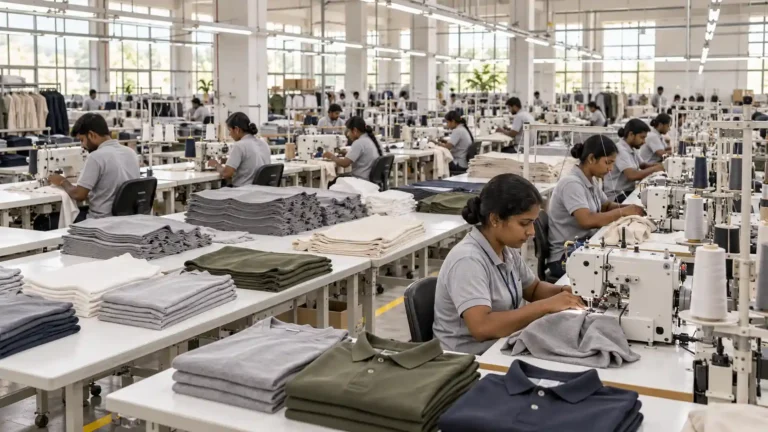
Mirthuni Apparel Sourcing Service provides garment manufacturing and sourcing support for international fashion brands, apparel importers, retailers and private-label clothing businesses. Based in Tiruppur, Tamil Nadu, India, we coordinate knitwear garment production through selected manufacturing partners, covering technical development, pattern making, sampling, cutting, sewing, finishing, quality control, private labeling and export packing.
Our core garment categories include regular and oversized T-shirts, polo shirts, sweatshirts, hoodies, joggers, knitted shorts, loungewear, sleepwear and children’s knitted apparel. Each production programme is evaluated according to the buyer’s tech pack, fabric construction, measurements, workmanship requirements, quantity, quality standards and delivery expectations.
Our approach combines manufacturing coordination with technical sourcing support, helping buyers manage the transition from approved development samples to consistent bulk garment production.
Complete Knitwear Garment Manufacturing and Sourcing Process
Garment manufacturing involves several connected operations that convert approved knitted fabric into finished apparel. Each stage requires suitable machinery, trained production personnel, documented specifications and appropriate inspection procedures.
Garment Production Workflow
Buyer Tech Pack and Specifications → Technical Review → Pattern Development → Fit Sampling → Sample Approval → Fabric and Trim Preparation → Fabric Relaxation → Marker Planning → Cutting → Panel Inspection → Sewing and Assembly → Inline Quality Control → Garment Finishing → Final Inspection → Labeling and Packing → Shipment Preparation
Printing, embroidery, garment dyeing and special washing operations are integrated at the appropriate stage according to the approved production route.
Tech Pack Interpretation and Pre-Production Planning
Production begins with a detailed review of the buyer’s technical requirements. A garment tech pack establishes the intended design, fit, construction, fabric specifications, size measurements, branding details and finishing expectations.
Mirthuni Apparel coordinates the review of technical documentation with relevant production partners to identify construction requirements, material availability, manufacturing feasibility and potential development issues before bulk production.
Important Tech Pack Information
- Garment design sketches and reference photographs
- Fabric composition, construction, GSM and finishing
- Measurement chart with points of measure and tolerances
- Size range and grading requirements
- Seam construction and stitch specifications
- Collar, cuff, rib and neckline requirements
- Printing and embroidery artwork with placements
- Brand labels, care labels, hangtags and trims
- Colourways and quantities per colour and size
- Packaging, testing and destination-market requirements
Where a complete tech pack is unavailable, reference garments, photographs and preliminary specifications may support an initial feasibility review. However, approved technical measurements and construction details are needed before reliable bulk production.
Pattern Making and Garment Engineering
Pattern development converts the garment design into individual components suitable for cutting and sewing. Pattern accuracy influences garment fit, proportions, fabric consumption, seam alignment and overall appearance.
Initial Pattern Development
Patterns are developed according to the approved garment silhouette, fabric stretch, body measurements, seam allowances and construction requirements. Different garment categories require different pattern approaches.
For example, oversized T-shirts may require a dropped shoulder, wider body and adjusted sleeve geometry, while fitted tops may require closer attention to fabric recovery, stretch and body shaping.
Digital Pattern Making and CAD Support
Suitable computer-aided design systems may be used for pattern preparation, grading and marker planning. Digital workflows can support repeatability, technical revisions and efficient material utilization.
Pattern Grading
Grading develops the approved base-size pattern into the required size range. Grading rules should follow the buyer’s measurement chart and intended fit rather than assuming that all garments can use the same proportional increments.
Fit Development Considerations
Regular-fit, oversized, boxy, relaxed, cropped, petite and children’s garments require different pattern proportions. Measurements should be assessed together with fabric elasticity, recovery, shrinkage and the intended garment silhouette.
Fit approval should be based on an actual sample made from the approved fabric or a technically representative material.
Garment Sampling and Fit Approval
Sampling allows buyers to evaluate garment measurements, construction, workmanship, fabric behaviour, decoration placement and overall appearance before bulk manufacturing.
Development Sample
An initial sample may be produced to evaluate design feasibility, construction and general fit. Technical adjustments are identified before further approval stages.
Fit Sample
A fit sample is used to review measurements, garment balance, proportions, sleeve shape, neckline and other fit-related requirements. Buyer comments are incorporated into the pattern and construction specifications.
Size-Set Sample
Where required, size-set samples are used to evaluate grading consistency across the intended size range.
Pre-Production Sample
A pre-production sample, commonly called a PP sample, is prepared to represent the approved garment construction, fabric, trims, branding and finishing before bulk production begins.
Mirthuni Apparel coordinates paid sampling. As part of our standard commercial arrangement, 50% of the agreed sample charges are adjusted against the bulk order once the order is confirmed, subject to the agreed quotation terms.
Fabric Relaxation and Preparation Before Cutting
Knitted fabrics may retain tension from knitting, dyeing, finishing, rolling and transportation. Controlled fabric relaxation before cutting helps reduce the risk of dimensional changes after garment panels are cut.
Relaxation requirements depend on fabric construction, elastane content, finishing history and the fabric supplier’s recommendations. Suitable conditions should be established before marker planning and cutting.
Fabric Inspection Before Cutting
Incoming fabric may be checked for shade, width, GSM, surface defects, spirality and dimensional behaviour. Fabric rolls should be identified and managed to reduce unintended mixing of different shades or production lots.
CAD Marker Planning and Fabric Cutting
Marker planning determines how garment pattern components are arranged across the usable fabric width. Efficient marker planning can reduce cutting waste while preserving the required grain direction, pattern alignment and garment quality.
Manual and Computerized Marker Planning
Marker preparation may be performed manually or through suitable CAD systems. The appropriate method depends on garment complexity, order quantity, fabric width and production setup.
Fabric Spreading
Fabric spreading prepares the required number of plies for cutting. Operators must control tension, alignment, lay height and fabric direction, particularly for stretch materials, stripes and directional prints.
Industrial Fabric Cutting
Cutting may use straight-knife, band-knife or suitable automated cutting systems, depending on the production programme and partner-factory capabilities.
Cut components are identified, counted and bundled according to garment style, size, colour and production sequence.
Stripe and Pattern Matching
Yarn-dyed stripes, engineered patterns and printed fabrics may require additional marker planning and cutting controls to achieve acceptable matching at seams and garment panels.
Industrial Sewing and Garment Assembly
Sewing converts cut garment components into completed apparel. The appropriate stitch and seam construction depend on fabric stretch, garment application, durability requirements and desired appearance.
Mirthuni Apparel coordinates sewing operations using suitable industrial garment machinery through selected manufacturing partners.
Single-Needle Lockstitch Sewing
Single-needle lockstitch machines are used for suitable straight seams, attachment operations, labels, decorative topstitching and selected construction details. Stitch selection must account for fabric stretch and seam requirements.
Overlock Sewing
Overlock machines are widely used for joining knitted fabric panels and controlling raw seam edges. Suitable three-thread, four-thread or five-thread configurations may be selected according to the operation and garment construction.
Coverstitch Sewing
Coverstitch machines are commonly used for T-shirt hems, sleeve hems and other knitwear finishing operations requiring stretch-compatible stitching. Two-needle and three-needle arrangements may be used according to the approved specification.
Flatseam and Flatlock Construction
Specialized flatseam equipment can produce relatively flat seams for suitable garments. Flatlock construction should not be confused with ordinary overlock stitching or decorative coverstitching.
Feed-Off-the-Arm Sewing
Feed-off-the-arm machines are used for selected tubular or enclosed seam operations where the machine configuration supports efficient handling and suitable seam construction.
Bar Tack Reinforcement
Bar tacking provides localized stitch reinforcement at selected stress points, such as pocket openings, drawcord openings or other approved garment details.
Buttonhole and Button Attachment
Polo shirts and other buttoned garments may require industrial buttonhole and button-sewing operations. Button position, attachment security and placket appearance must follow the approved technical specification.
Industrial Sewing Machinery and Applications
| Machine or Operation | Primary Function | Garment Applications |
|---|---|---|
| Single-needle lockstitch | Straight stitching and attachments | Polos, pockets, labels, decorative seams |
| Overlock | Joining and edge finishing | T-shirts, hoodies, joggers, sleepwear |
| Coverstitch | Stretch-compatible hems and finishes | T-shirts, sleeves, knit bottoms |
| Flatseam or flatlock | Low-profile seam construction | Selected stretch and close-fitting knitwear |
| Feed-off-the-arm | Selected tubular seam operations | Suitable sleeves and tubular components |
| Bar tack | Localized seam reinforcement | Joggers, shorts, pockets |
| Buttonhole and button sewing | Button closures | Polo shirts and buttoned garments |
| Elastic attaching equipment | Elastic waistband construction | Joggers, knitted shorts, sleepwear |
Garment Manufacturing and Sourcing Techniques
Regular and Oversized T-Shirt Manufacturing
T-shirt production includes neckline preparation, shoulder joining, neck rib attachment, sleeve setting, side seams and hem finishing. Oversized and drop-shoulder designs require appropriate pattern proportions and control of neckline shape, shoulder balance and sleeve placement.
Premium T-shirts may also require particular attention to heavy jersey handling, rib recovery, topstitching, seam consistency and final measurements.
Polo Shirt Manufacturing
Polo production involves collar preparation, placket construction, buttonhole and button attachment, sleeve finishing and hem construction. Flat-knitted collars and cuffs may be coordinated with the approved body fabric and garment design.
Collar alignment, placket symmetry, embroidery placement and button attachment are important inspection points.
Hoodie and Sweatshirt Manufacturing
Hoodies and sweatshirts may use French terry, fleece-base or other suitable knitted constructions. Manufacturing operations include rib attachment, sleeve and shoulder joining, hood assembly, kangaroo pocket attachment, zipper installation where applicable and final seam finishing.
Heavyweight garments require suitable machinery settings, needle selection, seam construction and handling to avoid excessive bulk or distortion.
Jogger and Knitted Short Manufacturing
Knit bottoms require particular attention to waistband construction, elastic attachment, drawcord channels, pocket assembly, crotch seams, inseam strength and leg opening finishes.
Fit evaluation should consider rise, hip allowance, thigh measurements, inseam length and the intended relaxed or tapered silhouette.
Loungewear and Sleepwear Manufacturing
Loungewear and sleepwear production emphasizes comfort, soft seam construction, dimensional stability, fit consistency and suitable garment-care requirements.
Matching sets may require additional controls for fabric shade, coordinated sizing and consistent finishing between tops and bottoms.
Children’s Knitwear Manufacturing
Children’s clothing requires age-appropriate pattern grading, secure trims, suitable seam construction and product-safety review according to the destination market.
Where applicable, requirements concerning small parts, drawstrings, flammability, chemical restrictions and labeling must be addressed before production. Compliance with a specific national or international standard must be verified rather than assumed.
Garment Manufacturing Applications by Product Category
| Garment | Main Construction Operations | Critical Quality Points |
|---|---|---|
| Regular T-shirts | Neck rib, shoulder, sleeve, side seams, hems | Neck shape, seam balance, shrinkage |
| Oversized T-shirts | Drop-shoulder assembly, heavy jersey sewing | Fit proportions, neckline stability |
| Polo shirts | Collar, placket, buttonholes, cuffs | Placket alignment, collar symmetry |
| Hoodies | Hood, pocket, rib cuffs, zipper where required | Hood shape, zipper alignment, seam strength |
| Sweatshirts | Body assembly, rib collar, cuffs, hem band | Rib recovery, seam bulk, fit |
| Joggers | Waistband, pockets, inseam, leg cuffs | Rise, waistband, seam durability |
| Knitted shorts | Elastic waist, pockets, leg hems | Elastic tension, fit, pocket strength |
| Sleepwear | Comfort seams, elastic, coordinated sets | Softness, shrinkage, fit consistency |
| Kidswear | Age-specific patterns, trims, secure assembly | Safety, labeling, workmanship |
Garment Printing and Embroidery Integration
Printing and embroidery may be completed before garment assembly or after sewing, depending on artwork placement, machinery access and the required production result.
Panel printing and embroidery can provide access to flat garment components before assembly. Finished-garment decoration may be suitable for selected chest logos, back prints and other accessible placements.
Specialty effects, all-over printing and garment washing require careful coordination with the cutting and sewing sequence to prevent misalignment, unexpected shrinkage or decoration damage.
Explore our Printing and Embroidery page for more information about available decoration methods.
Inline Garment Quality Control
Inline quality control identifies construction defects while garments are being manufactured, allowing corrective action before defects affect larger quantities.
Inspection checkpoints may include seam appearance, stitch formation, thread tension, component alignment, measurements, workmanship and decoration placement.
Common Inline Sewing Defects
- Skipped stitches and broken threads
- Uneven seam allowances
- Fabric puckering or seam distortion
- Open seams and incomplete stitching
- Incorrect component attachment
- Uneven collars, cuffs or plackets
- Incorrect labels or trim placements
- Measurement deviations
Quality checks are established according to the garment specifications, buyer requirements and production risk.
Garment Finishing and Final Presentation
After sewing, garments proceed through appropriate finishing operations to prepare them for final inspection and packing.
Thread Trimming and Cleaning
Loose threads and suitable processing residues are removed. Garments are checked for visible stains, workmanship defects and surface damage.
Pressing and Shape Setting
Suitable steam pressing or other garment presentation methods may be used according to the fabric composition and garment construction. Temperature, pressure and moisture must be controlled to avoid shine, distortion or damage.
Measurement Verification
Finished garments are measured against approved specifications and tolerances. The measurement procedure should be consistent with the buyer’s instructions, including any required relaxation or conditioning.
Final Appearance Inspection
Garments are reviewed for overall appearance, seam quality, shade consistency, branding accuracy and finishing defects before packing.
Private Labeling and Brand Customization
Mirthuni Apparel coordinates private-label garment manufacturing with suitable brand identification and packaging components.
Branding and Label Options
- Woven main brand labels
- Printed neck labels
- Size labels
- Wash-care and composition labels
- Country-of-origin labeling
- Hangtags and barcode stickers
- Custom drawcords, zippers and approved trims
- Branded packaging and carton markings
Label content must be reviewed against destination-market regulations and buyer instructions. Fibre composition, care information, origin statements and other required declarations should be supported by accurate product information.
Private-Label Manufacturing Checklist
Before bulk production: approve garment construction, fabric, colours, measurements, artwork, labels, trims, packaging and any required testing.
Before shipment: verify finished measurements, workmanship, assortment, labeling, carton markings and the agreed inspection documentation.
Garment Quality Assurance and Final Inspection
Final inspection evaluates whether finished garments meet the approved specifications and agreed workmanship requirements.
Depending on buyer instructions, inspection may follow an agreed sampling plan such as an ISO 2859-1-based acceptance sampling approach. Acceptance quality limits, defect classifications and inspection scope must be defined contractually rather than assumed.
Final Inspection Parameters
- Garment measurements and tolerances
- Fabric appearance and shade consistency
- Seam strength and stitch workmanship
- Print and embroidery appearance
- Collar, cuff, pocket and zipper construction
- Label accuracy and attachment
- Garment cleanliness and finishing
- Size and colour assortment
- Packaging and carton identification
Garment Testing and Buyer Compliance Requirements
Garment testing may be required to verify performance, safety and compliance with buyer specifications or destination-market regulations.
Common Garment and Fabric Tests
- Dimensional stability after laundering
- Colour fastness to washing, rubbing and perspiration
- Fabric pilling performance
- Seam strength and seam slippage where relevant
- Fabric bursting strength where specified
- Print and embroidery durability
- Applicable restricted-substance testing
- Children’s product safety and flammability where required
Testing can be coordinated through suitable laboratories when requested. Test scope, standards, sample selection and acceptance criteria should be agreed before testing.
Certifications held by individual manufacturing partners do not automatically certify Mirthuni Apparel or every garment produced through those partners. Product-level claims require appropriate verification.
Production Planning, Minimum Quantities and Lead Times
Production feasibility depends on garment complexity, fabric availability, colour count, decoration requirements, trims, order quantity and factory scheduling.
Our standard starting minimum order quantity is generally 300 pieces per colour per style for suitable knitwear programmes. Some product categories, including children’s clothing, specialty materials and custom-developed fabrics, may require different minimum quantities.
Development sampling is paid. The applicable sample quotation and schedule are confirmed after reviewing the technical requirements. Under our standard sampling arrangement, 50% of the agreed sample charges are adjusted against a confirmed bulk order, subject to the agreed commercial terms.
Bulk production lead times are confirmed according to material availability, approved samples, decoration requirements, production capacity and order details. No fixed production period should be assumed before technical and commercial review.
Export Packing and Shipment Preparation
Finished garments are folded, labeled, packed and prepared according to the buyer’s approved packing instructions.
Garment Packing Options
- Individual or assorted garment packing
- Size and colour assortment packing
- Approved protective packaging
- Barcode and product identification stickers
- Custom brand packaging where feasible
- Export carton packing and carton markings
- Carton count and packing-list verification
Mirthuni Apparel supports shipment coordination under agreed commercial terms, including FOB, CIF and DDP where commercially and operationally feasible. Final shipping arrangements depend on the destination, order volume, transport mode and import requirements.
Manufacturing and Sourcing Coordination for International Brands
Mirthuni Apparel operates as an apparel manufacturing and sourcing support business rather than representing every partner production facility as company-owned.
Our role includes coordinating suitable production partners, reviewing technical specifications, supporting material selection, organizing sampling, communicating production requirements, monitoring agreed quality checkpoints and assisting with export preparation.
This approach supports startup brands, established private-label businesses, retailers and international apparel importers seeking knitwear production in Tiruppur, India.
Related Apparel Manufacturing Resources
Garment production is connected to the preceding textile development stages. Explore our related resources:
- Fibres, Yarns and Material Compositions
- Knitting and Fabric Processing
- Fabric Dyeing, Washing and Finishing
- Apparel Printing and Embroidery
Request Garment Manufacturing and Sourcing Support
To evaluate your apparel manufacturing project, please provide the garment category, tech pack or reference images, fabric composition, GSM, size chart, colours, quantities per colour and style, artwork, branding requirements, packaging specifications and delivery destination.
Where applicable, please also include approved reference garments, measurement tolerances, testing standards and target commercial requirements.
Contact Mirthuni Apparel to discuss your garment manufacturing and sourcing requirements.
Frequently Asked Questions About Garment Manufacturing and Sourcing
1. What garment manufacturing services does Mirthuni Apparel provide?
Mirthuni Apparel coordinates knitwear garment manufacturing through selected production partners in Tiruppur, India. Support includes tech pack review, pattern development, sampling, cutting, stitching, garment assembly, printing and embroidery coordination, quality inspection, private labeling, packing and export preparation.
2. What types of knitted garments can Mirthuni Apparel manufacture?
Mirthuni Apparel supports regular and oversized T-shirts, polo shirts, sweatshirts, hoodies, joggers, knitted shorts, loungewear, sleepwear and suitable children’s knitted apparel. Production feasibility depends on fabric construction, garment complexity, specifications and minimum quantities.
3. Can Mirthuni Apparel develop patterns and samples from a tech pack?
Yes. Mirthuni Apparel coordinates pattern development, fit sampling, technical revisions and pre-production samples using buyer-provided tech packs, measurements and reference materials. Sampling is paid, with 50% of the agreed sample charges adjusted against a confirmed bulk order under the applicable commercial terms.
4. What sewing machines and stitch constructions are used for knitwear?
Suitable production partners may use industrial overlock, coverstitch, single-needle lockstitch, flatseam, feed-off-the-arm, bar-tack and other specialized equipment. The appropriate seam construction depends on garment design, fabric stretch, durability requirements and approved workmanship specifications.
5. Can Mirthuni Apparel manufacture oversized T-shirts and heavyweight hoodies?
Yes. Mirthuni Apparel supports development and production enquiries for oversized and drop-shoulder T-shirts, heavyweight sweatshirts and hoodies. Fabric GSM, pattern proportions, rib specifications, seam construction and finishing requirements are reviewed before confirming manufacturing feasibility.
6. Does Mirthuni Apparel support private labeling and custom garment packaging?
Yes. Private-label options may include woven labels, printed neck labels, wash-care labels, size labels, hangtags, barcode stickers, selected custom trims and branded packaging. Availability depends on buyer specifications, supplier minimums and applicable labeling requirements.
7. How is garment quality controlled during manufacturing?
Quality control may include incoming fabric checks, cutting inspection, inline sewing checks, measurement verification, decoration inspection and final garment inspection. Agreed workmanship standards, tolerances and sampling procedures are established according to buyer requirements and the production programme.
8. What is the minimum order quantity for custom garment manufacturing?
The standard starting minimum order quantity is generally 300 pieces per colour per style for suitable knitted apparel. Children’s clothing, specialty fabrics and custom-developed materials may require different minimum quantities. Trial quantities are reviewed individually according to technical and commercial feasibility.
9. Does Mirthuni Apparel support international shipping and export packing?
Yes. Mirthuni Apparel coordinates export packing, carton identification, shipment preparation and logistics arrangements according to agreed buyer requirements. Commercial shipping options may include FOB, CIF and DDP where feasible, subject to destination, order details and confirmed quotations.
10. What information is needed to request a garment manufacturing quotation?
Buyers should provide the garment type, tech pack or reference images, fabric composition, GSM, measurements, size range, colourways, quantity per colour and style, decoration artwork, labeling, packaging and destination requirements. Approved samples and applicable testing specifications are also helpful for evaluating feasibility, sampling and pricing.