Apparel Printing and Embroidery Manufacturing and Sourcing Support
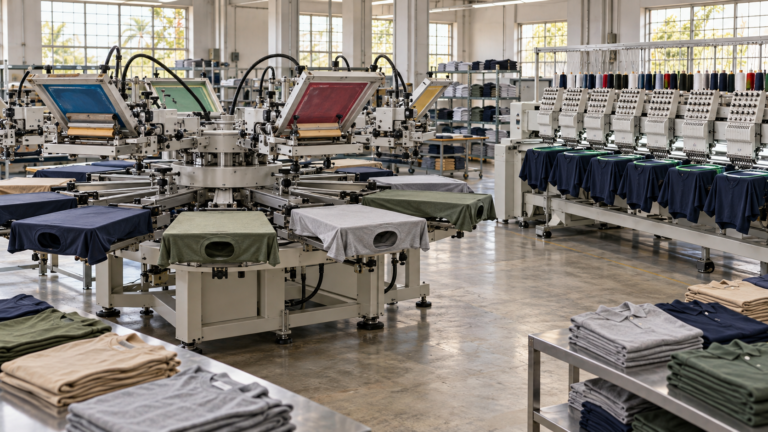
Mirthuni Apparel Sourcing Service provides custom apparel printing and embroidery manufacturing and sourcing support for international clothing brands, importers, retailers and private-label businesses. Based in Tiruppur, India, we coordinate garment decoration through selected manufacturing partners, including manual and automatic screen printing, digital printing, all-over fabric printing, transfer printing, computerized embroidery and selected hand embroidery techniques.
Our printing and embroidery programmes are developed according to garment type, fabric composition, artwork, print dimensions, colour count, production volume, hand-feel requirements and applicable chemical and quality standards.
We support decoration development for regular and oversized T-shirts, polo shirts, hoodies, sweatshirts, joggers, knitted shorts, loungewear, sleepwear, children’s clothing and suitable promotional apparel.
Apparel Printing and Embroidery in Tiruppur, India
Garment decoration is an important part of private-label apparel manufacturing. Printing allows brands to apply graphics, photographs, patterns, text and surface effects, while embroidery creates stitched logos, decorative motifs and textured designs.
Mirthuni Apparel coordinates printing and embroidery development with suitable manufacturing partners, helping buyers select appropriate methods based on fabric characteristics, artwork complexity, order quantity and intended product performance.
Printing may take place on individual fabric panels, completed garments or continuous fabric before cutting. The production stage influences design placement, registration, achievable coverage and manufacturing efficiency.
Manual Screen Printing for Custom Apparel
Manual screen printing is a widely used garment decoration process in which ink is transferred through a prepared mesh stencil onto fabric or garment panels. It is particularly suitable for repeat designs with a manageable number of colours and clearly defined placement areas.
Mirthuni Apparel coordinates screen-printing programmes using suitable water-based, PVC-free or other buyer-approved ink systems, subject to the required colour opacity, fabric compatibility, print effect and chemical compliance requirements.
Manual Flat-Table Screen Printing
Flat-table screen printing uses a long printing table on which fabric panels or garments are positioned for repeated manual printing. Operators control screen positioning, ink application and registration across the production run.
This method is suitable for chest graphics, back prints, sleeve artwork, children’s garment panels and selected large placement prints. It can also be useful where fabric panels are printed before cutting and sewing.
Manual Carousel Screen Printing
Manual carousel or rotary-table screen printing uses multiple printing stations arranged around a rotating framework. Garments are placed on pallets and moved between screens for successive colours or print effects.
This method is commonly used for repeated placement prints, brand graphics, promotional designs and small-to-medium production programmes. Print consistency depends on screen preparation, registration, ink control, curing and operator skill.
Manual Screen Printing — Suitable Applications
- Left-chest and centre-chest prints
- Large front and back T-shirt graphics
- Sleeve logos and garment-panel artwork
- Single-colour and selected multicolour designs
- Water-based and compatible specialty print effects
- Private-label and promotional garment programmes
Manual screen printing is often commercially attractive for repeat artwork with limited colours, although the most economical method depends on design dimensions, quantities and production setup.
Automatic Screen Printing for High-Volume Apparel Production
Automatic screen-printing equipment uses mechanized print heads, indexed garment pallets and controlled printing cycles to improve repeatability and production output. Operators remain responsible for setup, ink preparation, loading, unloading, registration checks and quality control.
Automatic carousel systems are particularly useful for larger production quantities, multicolour placement graphics and artwork requiring consistent registration across repeated garments.
Depending on machine configuration, ink compatibility and artwork requirements, automatic screen printing can support standard flat prints as well as selected high-density, puff, specialty ink and decorative transfer-related applications.
Benefits of Automatic Screen Printing
- Repeatable print registration
- Consistent squeegee pressure and printing cycles
- Higher production throughput for suitable programmes
- Improved consistency across larger garment quantities
- Support for multiple print stations and colour separations
- Compatibility with selected specialty print techniques
Automatic printing is not automatically the best choice for every design. Small quantities, frequently changing artwork or photographic graphics may be better suited to digital or transfer-based methods.
Specialty Screen Printing Techniques
Flat Printing
Flat printing creates a relatively smooth printed graphic on the fabric surface. The final hand feel depends on ink chemistry, print deposit, fabric structure and curing conditions.
High-Density Printing
High-density printing produces a thicker, raised ink deposit with a defined three-dimensional appearance. It requires compatible ink systems, stencil thickness, controlled print buildup and suitable curing.
Puff Printing
Puff printing uses specially formulated ink containing an expansion system that creates a raised, textured effect during controlled heating. Puff height, edge definition and durability depend on the formulation, artwork and curing conditions.
Glitter Printing
Glitter printing incorporates suitable decorative particles into an approved print system to create a reflective surface. Particle retention, washing durability and applicable product-safety requirements should be verified, particularly for children’s garments.
Foil Transfer Printing
Foil printing uses a compatible adhesive and heat-transfer foil to produce metallic or reflective surface effects. The process requires suitable application conditions and testing for adhesion, cracking and wash durability.
Water-Based and Soft-Hand Printing
Water-based printing systems may provide a softer fabric hand, particularly on suitable cotton fabrics. Print opacity and durability depend on formulation, pigment loading, fabric colour and curing conditions.
Discharge Printing Where Permitted
Discharge printing can remove or modify suitable pre-existing fabric colour to produce selected print effects. Its feasibility depends on the original dye system and the use of approved chemistry. Restricted or unsuitable discharge chemicals must not be used.
Manual and Automatic Screen Printing Comparison
| Parameter | Manual Screen Printing | Automatic Screen Printing |
|---|---|---|
| Equipment | Flat table or manual carousel | Mechanized carousel and print heads |
| Operator involvement | High during printing | Focused on setup, loading and supervision |
| Typical production | Small and medium repeat runs | Medium and large repeat runs |
| Colour registration | Operator-controlled | Mechanically indexed |
| Special effects | Flat, puff, high-density, glitter and selected effects | Similar effects subject to equipment and chemistry |
| Primary advantage | Flexible setup for suitable artwork | Higher throughput and repeat consistency |
Digital Direct-to-Garment Printing
Direct-to-garment printing, commonly called DTG, uses digital inkjet technology to apply artwork directly onto suitable garments. It is particularly useful for detailed graphics, photographic images, gradients and artwork containing many colours.
DTG is commonly evaluated for cotton and suitable cotton-rich T-shirts, sweatshirts and hoodies. Depending on the garment colour and ink system, pretreatment, white underbase printing and controlled curing may be required.
Digital printing reduces the need for individual screens for each artwork colour, but fabric suitability, pretreatment, ink performance and curing remain important.
Suitable DTG Applications
- Photographic T-shirt artwork
- Detailed multicolour illustrations
- Small-run private-label graphics
- Complex colour gradients
- Personalized artwork and limited-edition collections
Raised puff and high-density effects are not standard outputs of conventional DTG equipment. Where these effects are required, a separate compatible specialty printing or transfer process may be necessary.
All-Over Printing for Knitwear Fabrics
All-over printing, often abbreviated as AOP, applies patterns across the full usable fabric width or across garment panels. It is widely used for children’s clothing, pajamas, sleepwear, loungewear, printed T-shirts and other patterned knitted apparel.
Mirthuni Apparel coordinates all-over printing through suitable textile printing partners, with the production method selected according to fibre composition, design repeat, colour count, print coverage and order volume.
Rotary Screen Printing for All-Over Fabric Designs
Rotary screen printing uses cylindrical screens to apply repeating patterns onto fabric moving through a continuous printing line. Separate screens are generally required for individual colours, depending on the design and printing system.
This method is suitable for commercially repeatable all-over patterns such as children’s motifs, floral designs, geometric prints, sleepwear patterns, stripes and other repeated artwork.
Rotary printing can be efficient for suitable medium-to-large fabric programmes, particularly where a repeat design will be produced consistently over substantial fabric lengths.
Digital Textile Printing for All-Over Designs
Digital textile printing uses computer-controlled inkjet technology to print patterns directly onto suitable fabric. It can reproduce complex multicolour artwork, gradients and detailed illustrations without preparing an individual rotary screen for each colour.
The appropriate ink system and pretreatment depend on the fibre composition. Cotton and cellulosic fabrics may use suitable reactive or pigment digital systems, while polyester fabrics require compatible colouration methods.
Digital textile printing is particularly valuable for artwork requiring high detail, multiple colours, frequent design changes or complex repeats.
All-Over Printing Artwork Development
- Repeat dimensions and seamless pattern continuity
- Artwork scale and motif positioning
- Colour references and approved strike-offs
- Fabric composition and knitting construction
- Print width and usable fabric width
- Pattern alignment and garment cutting requirements
- Colour fastness and dimensional stability
- Production quantity and method feasibility
All-Over Printing: Rotary vs Digital
Rotary screen printing is commonly suitable for repeating patterns produced at commercially efficient fabric volumes. It requires screen preparation and colour separation.
Digital textile printing is well suited to intricate artwork, photographic detail, multicolour designs and programmes where design flexibility is important.
The best method depends on fabric composition, design complexity, required quantity, colour performance and total production cost.
Direct-to-Film Printing for Garment Branding
Direct-to-film printing, or DTF, is a transfer printing process in which artwork is printed onto a special film, combined with a compatible adhesive system and transferred to the garment using controlled heat and pressure.
DTF is used for brand logos, detailed graphics, names, school or event identification, promotional designs and other garment branding applications.
The method can be considered for suitable cotton, polyester and blended fabrics, subject to fabric compatibility and testing.
DTF Applications
- Private-label logos
- School and institutional garment branding
- Event and promotional T-shirts
- Photographic or multicolour artwork
- Personalized names and numbers
- Small or variable artwork programmes
Transfer temperature, pressure, dwell time, adhesive compatibility and washing durability must be controlled. Large solid transfers may affect fabric breathability and hand feel, so print dimensions should be considered during artwork development.
Dye-Sublimation Printing for Compatible Polyester Fabrics
Dye sublimation uses heat to transfer suitable disperse dyes into compatible polyester-based textile materials. Unlike DTF, it does not normally rely on a conventional adhesive film layer remaining on the garment surface.
Sublimation can produce detailed graphics and all-over patterns on suitable polyester-rich fabrics. Results depend on fibre composition, fabric preparation, transfer conditions and colour-management controls.
Because Mirthuni Apparel primarily specializes in cotton and other knitted casualwear materials, sublimation requirements are evaluated individually for suitable products rather than presented as a core polyester activewear manufacturing programme.
Printing Methods and Garment Applications
| Garment Category | Suitable Printing Methods | Typical Artwork |
|---|---|---|
| Regular T-shirts | Screen, DTG, DTF | Chest graphics, back prints, logos |
| Oversized T-shirts | Screen, puff, high-density, DTG, DTF | Streetwear graphics and raised effects |
| Polo shirts | Screen, DTF, selected transfers | Small logos and sleeve branding |
| Hoodies and sweatshirts | Screen, puff, high-density, DTG, DTF | Large graphics and brand motifs |
| Kidswear | Rotary AOP, digital textile, screen | Repeated motifs and character-style patterns |
| Pajamas and sleepwear | Rotary AOP, digital textile printing | Florals, geometric repeats, seasonal designs |
| Loungewear | Screen, AOP, digital textile | Placement prints and coordinated patterns |
| Promotional apparel | Screen, DTF, selected digital methods | Event names, logos, campaign artwork |
Computerized Machine Embroidery for Apparel
Computerized embroidery uses programmed stitching instructions to reproduce logos, lettering, decorative motifs and other stitched designs. Industrial multi-head embroidery machines can produce repeated artwork across multiple garment panels or garments within a production programme.
Mirthuni Apparel coordinates embroidery digitizing, thread selection, backing materials, stitch development, placement approval and production through selected embroidery partners.
Embroidery may be applied to fabric panels before garment assembly or to suitable completed garments, depending on the design, access requirements and construction.
Flat Embroidery and Satin Stitch
Flat embroidery is commonly used for chest logos, lettering and decorative motifs. Satin stitches are often used for borders and narrow lettering, while fill stitches cover larger design areas.
Running Stitch and Outline Embroidery
Running stitches are suitable for fine outlines, decorative linework and selected lightweight designs. Stitch density and thread tension must be matched to the fabric to reduce distortion.
Chain Stitch and Chenille Embroidery
Chain stitching creates a linked decorative stitch appearance. Chenille embroidery uses specialized equipment or techniques to create a soft, textured, looped or pile-like design effect.
These techniques may be considered for premium sweatshirts, hoodies and fashion-oriented knitwear, subject to machine availability and fabric suitability.
Appliqué Embroidery
Appliqué combines a separate fabric piece with stitched attachment and decorative edging. It can create larger motifs with less dense embroidery coverage than a fully stitched fill design.
Appliqué is often suitable for heavyweight sweatshirts, hoodies, varsity-inspired garments and selected children’s clothing.
Sequin Embroidery
Sequin embroidery uses suitable machine attachments or specialist processes to attach decorative sequins to fabric. It is used for selected fashion motifs and decorative effects.
Sequin security, sharp edges, wash durability and age-appropriate safety requirements must be considered, especially for children’s apparel.
3D Puff Embroidery
Three-dimensional puff embroidery uses suitable foam beneath dense stitching to produce raised embroidered lettering or motifs. It is most suitable for designs and garment materials capable of supporting the required stitch density and thickness.
Traditional Hand Embroidery and Decorative Handwork
Selected premium apparel designs may require hand embroidery rather than machine embroidery. Mirthuni Apparel can evaluate specialist handwork requirements through suitable manufacturing partners where commercially feasible.
Possible techniques include hand-stitched motifs, beadwork, decorative thread embroidery, selected sequins and mixed-material embellishments.
Hand embroidery requires careful assessment of artwork complexity, workmanship, production time, embellishment security and garment care requirements. It is generally more labour-intensive than computerized embroidery.
Embroidery Methods and Apparel Applications
| Embroidery Method | Recommended Garments | Technical Considerations |
|---|---|---|
| Flat logo embroidery | Polos, T-shirts, sweatshirts | Stitch density, backing, placement |
| Satin and running stitches | Polos, casualwear, kidswear | Line width, thread tension, legibility |
| Chenille and chain stitch | Hoodies, heavyweight sweatshirts | Texture, equipment, fabric support |
| Appliqué | Streetwear, sweatshirts, kidswear | Patch attachment and edge durability |
| Sequin embroidery | Fashion tops, decorative apparel | Attachment security and safety |
| 3D puff embroidery | Heavyweight hoodies, sweatshirts | Foam coverage and stitch durability |
| Hand embroidery and beads | Premium fashion and limited collections | Workmanship, attachment and care |
Print and Embroidery Placement Development
Artwork placement is coordinated with garment measurements, neckline position, seams, pockets, zippers and the intended fit. A placement suitable for a regular-fit T-shirt may require adjustment for an oversized or drop-shoulder silhouette.
Common Decoration Placements
- Left chest and centre chest
- Full front and full back
- Upper back and back-neck area
- Sleeves and shoulder panels
- Hoodie chest and back panels
- Polo shirt chest logos
- Jogger and knitted-short leg placements
- All-over fabric and engineered panel patterns
Approved placement measurements, artwork dimensions and production samples are recommended before bulk manufacturing.
Ink Chemistry, AZO Restrictions and Chemical Compliance
Mirthuni Apparel supports printing programmes using suitable water-based, PVC-free and other buyer-approved ink systems according to the required print technique and performance specification.
Printing inks, pigments, adhesives, binders, curing agents and embroidery accessories must be assessed against applicable restricted-substance requirements. This may include restrictions concerning specified aromatic amines from azo colourants, heavy metals, phthalates, formaldehyde or other regulated substances, depending on the product and destination market.
Commercial descriptions such as “azo-free”, “PVC-free” or “water-based” do not by themselves establish complete chemical compliance. Relevant supplier declarations, chemical documentation and laboratory testing should support claims made for a specific product.
Printing and Embroidery Chemical Safety Controls
- Selection of suitable, buyer-approved inks and auxiliaries
- Review of restricted-substance requirements
- Verification of ink and adhesive compatibility
- Controlled printing and curing conditions
- Review of embroidery thread and embellishment suitability
- Relevant colour fastness and durability testing
- Laboratory verification where specified by the buyer
Test reports can be coordinated through appropriate laboratories when required. Testing scope, sampling, cost and acceptance criteria must be agreed before testing. No universal guarantee is made without verification of the specific production lot and required standard.
Printing and Embroidery Quality Control
Decoration quality is evaluated against approved artwork, colour references, placement specifications, workmanship standards and applicable performance requirements.
Screen and Digital Printing Quality Checks
- Artwork dimensions and placement accuracy
- Colour matching and registration
- Print coverage and edge definition
- Ink curing and transfer adhesion
- Wash durability and colour fastness
- Dry and wet rubbing fastness where relevant
- Cracking, peeling and excessive surface stiffness
- Fabric distortion and garment appearance
Embroidery Quality Checks
- Approved digitized artwork and thread colours
- Logo size and positioning
- Stitch density and coverage
- Thread breaks, loose stitches and trimming
- Fabric puckering and distortion
- Backing and stabilizer suitability
- Appliqué and embellishment attachment security
- Appearance after laundering where specified
Artwork Preparation and Sample Approval
Accurate artwork preparation is essential for successful printing and embroidery. Buyers should provide suitable design files, colour references, garment specifications and the intended decoration method.
Screen printing may require colour separation and screen development. Digital printing requires suitable image resolution and colour management. Embroidery requires stitch digitization rather than simply converting a raster image into a machine file.
Sample approval should cover appearance, colour, placement, hand feel and applicable durability requirements before bulk production.
Custom Apparel Decoration for International Buyers
Mirthuni Apparel coordinates printing and embroidery as part of broader apparel manufacturing and sourcing support for international brands, retailers, importers and promotional garment buyers.
Our team assists with selecting suitable decoration methods, evaluating artwork feasibility, coordinating development samples and supporting production quality requirements through selected manufacturing partners.
For related manufacturing stages, explore our Fibres, Yarns and Material Compositions, Knitting and Fabric Processing and Fabric Dyeing and Finishing resources. Confirm the destination URLs match the published page slugs.
Request Custom Printing and Embroidery Support
To review a printing or embroidery project, please provide the garment type, fabric composition, target GSM, artwork files, design dimensions, placement details, colour references, preferred printing or embroidery method, quantities per design and colour, size range and any required testing or chemical compliance standards.
For all-over printing, include the repeat dimensions and required fabric width. For embroidery, include logo dimensions, thread colours and reference samples where available.
Contact Mirthuni Apparel to discuss your custom apparel printing and embroidery requirements.
Frequently Asked Questions About Apparel Printing and Embroidery
1. What apparel printing and embroidery methods does Mirthuni Apparel support?
Mirthuni Apparel coordinates manual and automatic screen printing, specialty prints, direct-to-garment printing, rotary and digital all-over printing, DTF transfers, suitable sublimation applications, computerized embroidery and selected hand embroidery through manufacturing partners. Method selection depends on fabric composition, artwork, garment category, quantity and technical feasibility.
2. What is the difference between manual and automatic screen printing?
Manual screen printing relies more heavily on operators to apply ink and manage print cycles using flat tables or manual carousels. Automatic screen printing uses mechanized print heads and indexed pallets to improve repeatability and output for suitable production programmes. Both can support selected specialty effects depending on equipment and ink compatibility.
3. Can Mirthuni Apparel develop puff, high-density, glitter and foil prints?
Yes. Mirthuni Apparel can coordinate development of puff, high-density, glitter and foil print effects through suitable printing partners. Each technique requires compatible ink or transfer systems, artwork preparation, curing and durability testing. Feasibility depends on the fabric, design and buyer requirements.
4. What is the difference between rotary and digital all-over fabric printing?
Rotary screen printing uses cylindrical screens to apply repeated designs and is commonly suited to commercially repeatable fabric programmes. Digital textile printing uses inkjet technology to reproduce detailed multicolour patterns without individual screens for each colour. The preferred method depends on fabric composition, design complexity, quantity and required performance.
5. Can Mirthuni Apparel print all-over designs for children’s clothing and sleepwear?
Yes. Mirthuni Apparel supports all-over printed fabric development for suitable children’s clothing, pajamas, sleepwear and loungewear. Designs may include repeated motifs, florals, geometric patterns and seasonal artwork. Fabric compatibility, repeat dimensions, colour approval and applicable product-safety requirements must be reviewed.
6. What is the difference between DTF, DTG and sublimation printing?
DTF prints artwork onto a transfer film and applies it to a garment using an adhesive system and heat. DTG prints suitable inks directly onto a garment, commonly cotton-rich products. Dye sublimation transfers compatible disperse dyes into suitable polyester-based materials. Each process has different fabric compatibility, hand feel and production considerations.
7. What types of machine embroidery can Mirthuni Apparel coordinate?
Mirthuni Apparel coordinates computerized flat embroidery, satin and running stitches, fill stitching, selected chain and chenille effects, appliqué, sequin embroidery and suitable raised embroidery techniques through specialist partners. Applications include polo logos, sweatshirt motifs, hoodie branding and decorative apparel designs.
8. Does Mirthuni Apparel support hand embroidery and beadwork?
Selected hand embroidery, decorative beadwork and specialist embellishment enquiries can be evaluated through suitable manufacturing partners. Feasibility depends on artwork complexity, material availability, workmanship requirements, order quantity, production time and garment-care considerations.
9. Are printing inks and embroidery materials tested for chemical safety and durability?
Mirthuni Apparel supports buyer requirements for suitable ink systems, applicable restrictions on hazardous substances and relevant decoration durability testing. Supplier documentation and laboratory reports can be coordinated where required. Compliance is determined by the specified standard and verified test results rather than an unconditional claim that all materials are certified.
10. What information is required for a custom apparel printing or embroidery quotation?
Buyers should provide the garment category, fabric composition, GSM, artwork files, design dimensions, print or embroidery placement, colour references, required decoration method, quantity per design and colour, size range and applicable testing requirements. All-over printing requires pattern-repeat details, while embroidery benefits from logo measurements and reference samples.