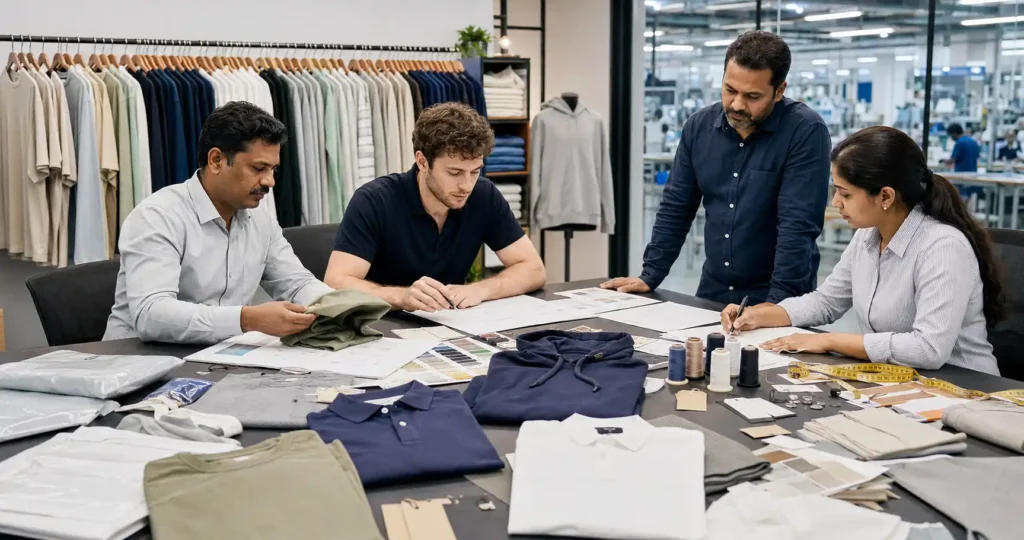
Finding the right apparel manufacturer in India involves much more than comparing garment prices. For an international clothing brand, the manufacturing partner you select can influence fabric quality, garment fit, product consistency, delivery reliability and ultimately how customers perceive your brand.
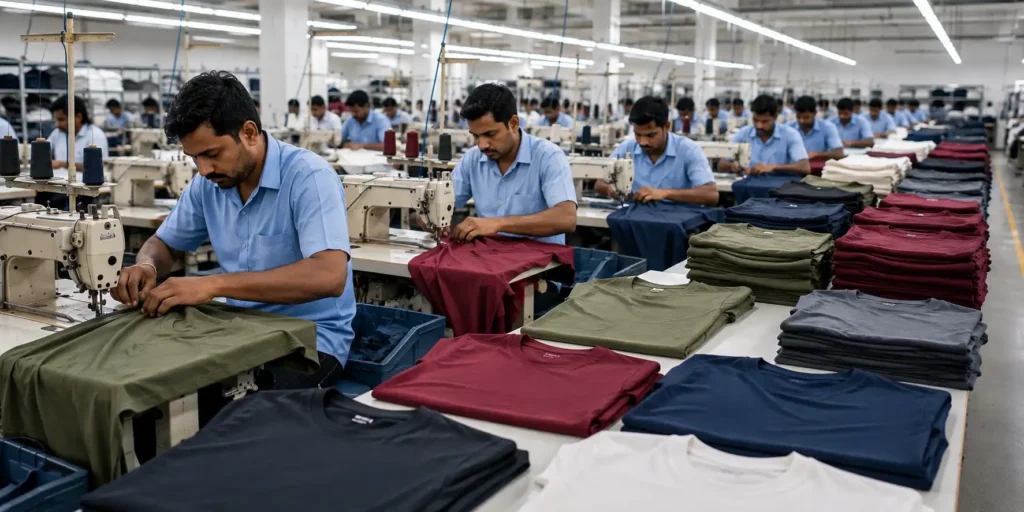
India has a broad textile and apparel manufacturing ecosystem covering yarn production, knitting, weaving, dyeing, garment manufacturing, printing, embroidery, finishing and export. Within this ecosystem, manufacturing clusters such as Tiruppur have developed substantial specialization in knitted apparel.
For buyers, however, having many potential suppliers creates another challenge: how do you determine which manufacturer or sourcing partner is suitable for your particular product?
A structured supplier-evaluation process should examine product specialization, fabric capability, product development, sampling, minimum order quantities, quality control, customization, production coordination and export support before a bulk order is confirmed.
Define Your Product Before Searching for a Manufacturer
The first step is to define what you actually want to manufacture.
A supplier that is suitable for one product category may not necessarily be the best choice for another. Knitwear, woven garments, performance apparel and highly structured fashion products can require different fabrics, machinery, technical knowledge and production systems.
Before approaching a supplier, prepare as much information as possible about your product.
Useful information includes:
- Garment type
- Men’s, women’s, kids’ or unisex sizing
- Intended fit
- Fabric composition
- Approximate GSM
- Colour requirements
- Size range
- Order quantity
- Printing or embroidery requirements
- Labels and trims
- Packaging requirements
- Target market
- Expected quality level
- Reference garment or technical drawing
- Tech pack, where available
A clear product brief allows a supplier to assess feasibility more accurately and reduces unnecessary revisions during sampling.
For established products, a detailed tech pack can provide measurements, construction details, artwork placements, trims and finishing requirements. Emerging brands without a complete tech pack may instead need more product-development assistance from their sourcing or manufacturing partner.
Look for Relevant Product Specialization
One of the most important questions when evaluating an apparel manufacturer in India is whether the supplier regularly works with your type of garment.
A manufacturer with experience in knitted T-shirts, for example, may understand single jersey fabrics, rib specifications, neck construction, shrinkage behaviour, printing and garment finishing particularly well.
For private-label knitwear programs, common product categories can include:
- T-shirts
- Polo shirts
- Hoodies
- Sweatshirts
- Joggers
- Loungewear
- Sleepwear
- Kidswear
- Selected corporate apparel
Product specialization matters because garment development is interconnected with fabric selection, pattern development, construction, finishing and quality requirements.
Instead of asking only “Can you manufacture this?”, buyers should ask whether the supplier has experience developing and coordinating similar products, fabrics and quality levels.
Evaluate Fabric Sourcing Capability
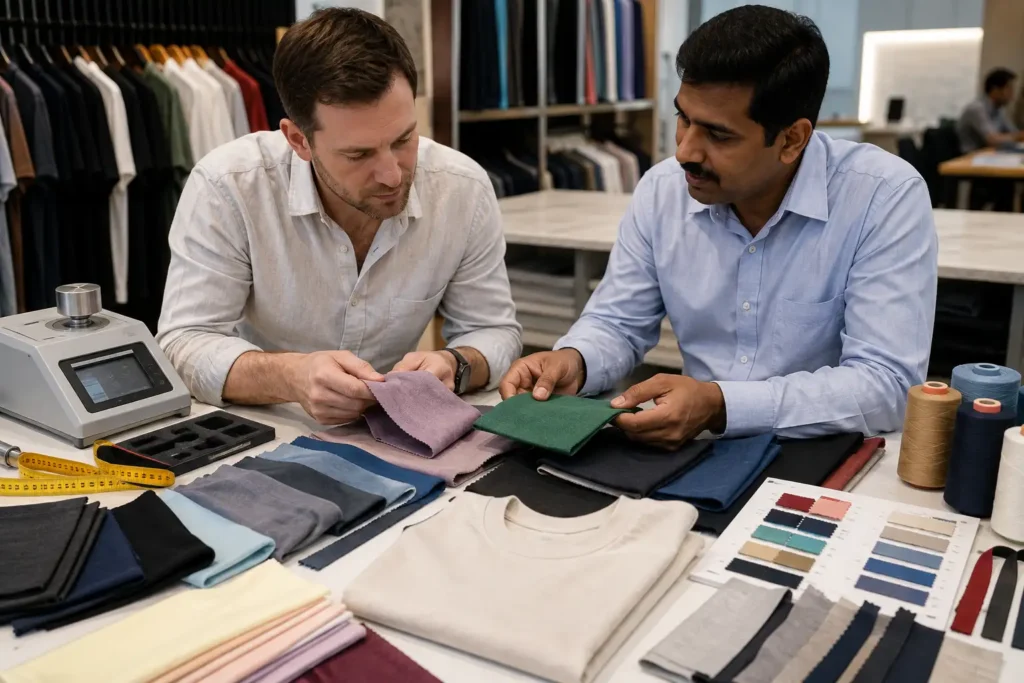
Fabric is one of the most important components of a garment.
Two manufacturers can receive the same garment drawing and still produce noticeably different results if the yarn, fabric construction, knitting, dyeing and finishing are different.
When discussing knitted apparel, buyers should understand specifications such as:
- Fibre composition
- Yarn quality
- Fabric construction
- GSM
- Knitting structure
- Colour development
- Shrinkage
- Hand feel
- Surface appearance
- Fabric finishing
Common knitted constructions include single jersey, interlock, rib, pique, French terry and fleece.
Depending on the product and positioning, brands may also evaluate cotton, cotton-rich blends, organic cotton, modal, lyocell and other suitable fibres.
A reliable sourcing process should therefore begin with the right fabric specification, rather than selecting a garment solely from a photograph.
Understand MOQ Before Comparing Suppliers
Minimum order quantity, or MOQ, is often one of the first questions a clothing brand asks.
However, MOQ is not simply a number chosen by a manufacturer.
In apparel production, minimum quantities can be influenced by:
- Fabric knitting requirements
- Yarn availability
- Dyeing batch quantities
- Number of colours
- Fabric composition
- GSM
- Garment style
- Printing or embroidery
- Custom trims
- Size breakdown
- Packaging requirements
A supplier quoting an unusually low MOQ should therefore be able to explain how the fabric and production will be handled at that quantity.
For buyers, the better question is:
What production process determines the MOQ for this particular product?
Understanding that relationship helps brands distinguish between a commercially workable production plan and a quantity offered simply to win an enquiry.
Assess Sampling and Product Development Support
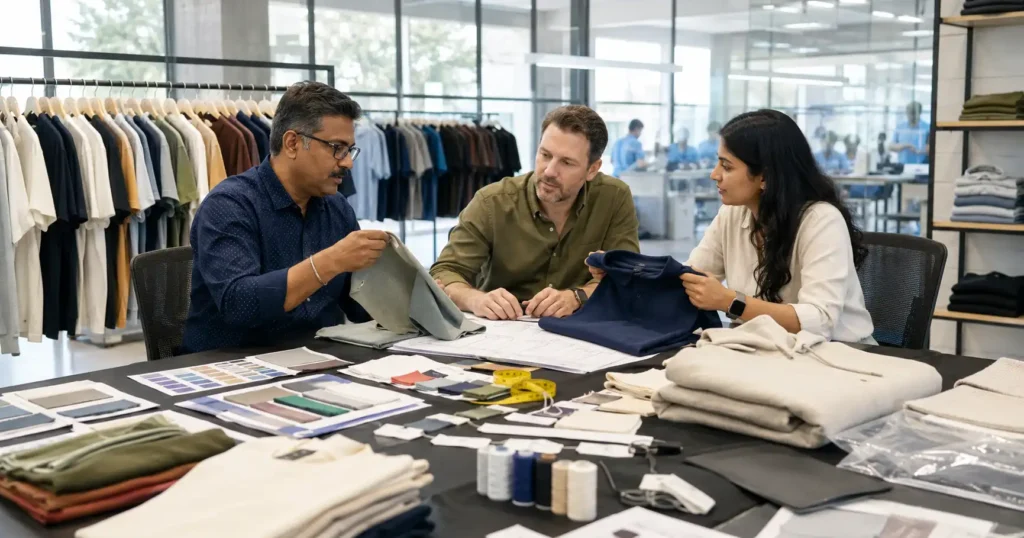
Sampling is where a product specification becomes a physical garment.
This stage allows the buyer and supplier to evaluate areas such as:
- Fabric
- Fit
- Measurements
- Construction
- Stitching
- Colour
- Print or embroidery
- Labels
- Trims
- Washing
- Finishing
- Overall appearance
A first sample should not automatically be treated as the final production standard. Depending on the product, revisions may be required before approval.
International buyers should establish how sample comments will be recorded and how revised specifications will be communicated to production.
Sampling is especially important for private-label brands because fit, fabric and finishing are part of the brand’s product identity.
Examine Quality Control Before Placing a Bulk Order
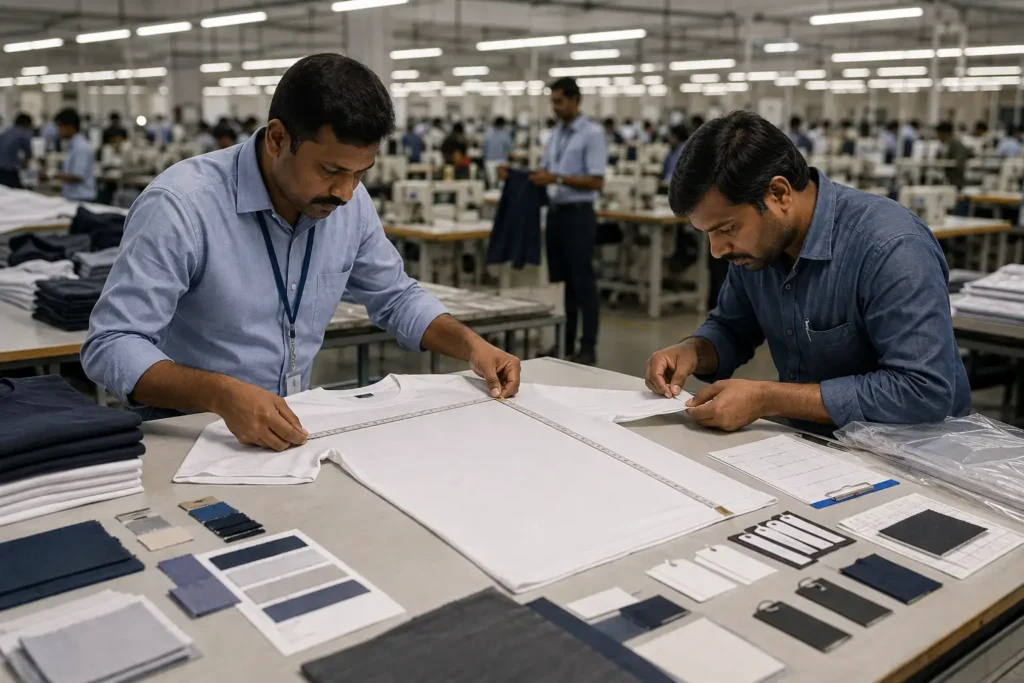
Quality control should not begin only when finished garments are packed.
A structured apparel quality process can involve checks at several stages of production.
Before production
Confirm:
- Approved fabric
- Approved colour
- Measurements
- Construction details
- Trims
- Artwork
- Label positions
- Packaging requirements
During production
Depending on the order, inspections may review:
- Cutting
- Sewing workmanship
- Measurements
- Print or embroidery placement
- Construction consistency
- Visible defects
- Production conformity
Before shipment
Final checks can include:
- Finished measurements
- Workmanship
- Appearance
- Labels
- Folding
- Packing
- Assortment
- Carton information
The exact quality-control procedure should correspond to the product, buyer requirements and agreed inspection standard.
For an international brand, understanding how quality is controlled can be more valuable than simply being told that the supplier produces “high-quality garments.”
Check Private Label and Customization Capabilities
Private-label manufacturing involves more than attaching a brand name to a standard garment.
Depending on the product, customization may include:
- Custom fabric
- Brand colours
- Screen printing
- DTF printing
- DTG printing
- Puff printing
- Embroidery
- Neck labels
- Size labels
- Wash-care labels
- Woven labels
- Hangtags
- Branded packaging
- Carton specifications
Brands should provide artwork and branding requirements early enough for the supplier to assess production methods, minimums, cost and lead time.
The objective is to integrate branding into the production program rather than treating it as an afterthought immediately before shipment.
Evaluate Communication and Production Coordination
For overseas manufacturing, communication is part of production control.
A capable supplier or sourcing partner should be able to communicate clearly about:
- Product specifications
- Fabric development
- Sample status
- Approvals
- Production progress
- Quality issues
- Packing
- Documentation
- Shipment readiness
Buyers should also understand who is responsible for each stage.
This becomes particularly important when a sourcing company coordinates production through selected manufacturing partners. The sourcing partner should provide a clear point of communication while ensuring the relevant factory, fabric and processing capabilities are aligned with the buyer’s product.
Good coordination reduces the risk of information becoming fragmented between the buyer, fabric supplier, garment unit, printer, embroiderer, finishing unit and packaging supplier.
Understand Export and Shipping Support
Manufacturing a garment successfully is only part of an international apparel order. The finished goods must also be prepared correctly for export.
Depending on the commercial arrangement, buyers may need support with:
- Export packing
- Carton planning
- Packing lists
- Commercial invoices
- Export documentation
- Freight coordination
- FOB shipments
- DDP arrangements where applicable
The appropriate Incoterm and logistics arrangement should be agreed before production so both parties understand their respective responsibilities and costs.
A buyer importing for the first time may require more coordination than an established importer with nominated freight forwarders and established shipping procedures.
Compare Capability, Not Just Garment Price
Price matters, but the lowest quotation does not necessarily represent the lowest total sourcing cost.
A quotation should be evaluated alongside:
- Fabric specification
- Garment construction
- Product-development support
- MOQ
- Sampling
- Quality-control process
- Communication
- Production reliability
- Customization
- Packing
- Export capability
A lower garment price can become expensive if the product requires repeated corrections, suffers inconsistent quality or misses the required delivery window.
For mid-market and premium private-label programs in particular, buyers should compare overall manufacturing capability and sourcing reliability, not simply the first FOB price received.
Why Tiruppur Is Relevant for Knitwear Sourcing
Tiruppur in Tamil Nadu is internationally associated with knitted garment production and its supporting textile ecosystem.
For clothing brands sourcing knitwear, the concentration of related capabilities can support product development across fabric, dyeing, garment production, printing, embroidery, finishing, packaging and export activities.
This makes Tiruppur particularly relevant for products such as T-shirts, polos, sweatshirts, hoodies, loungewear, sleepwear and other knitted apparel.
However, location alone should never determine supplier selection. Buyers should still evaluate the specific production network, product expertise, quality procedures and communication model offered for their program.
Working With an Apparel Manufacturing and Sourcing Partner
Not every international buyer needs to work directly with a single garment factory.
For brands developing multiple knitted products, fabrics or processes, an apparel sourcing partner can help coordinate the different stages required to move from concept to shipment.
Mirthuni Apparel provides apparel manufacturing and sourcing support from Tiruppur, India, with manufacturing coordinated through selected manufacturing partners according to product requirements.
The support model can include:
- Product requirement review
- Fabric sourcing
- Product development
- Sampling coordination
- Private-label customization
- Manufacturing partner coordination
- Quality control
- Packaging coordination
- Export support
This model can be particularly useful when a buyer wants one point of coordination while different specialist capabilities are required across the supply chain.
Final Checklist Before Selecting an Apparel Manufacturer in India
Before confirming a supplier, an international clothing brand should be able to answer the following questions:
- Does the supplier understand my product category?
- Can the required fabric be sourced or developed?
- Are the MOQ requirements commercially workable?
- Is there a structured sampling process?
- Are measurements and construction specifications documented?
- How will bulk production quality be monitored?
- Can the required printing, embroidery and branding be coordinated?
- Are labels, trims and packaging supported?
- Is communication clear and documented?
- Can the supplier support export requirements?
- Are commercial terms clearly agreed?
- Is the production model suitable for repeat orders and future growth?
The objective is not simply to find a company capable of sewing a garment. It is to identify an apparel manufacturer in India or sourcing partner whose product capability, processes and communication are appropriate for your brand.
For international clothing businesses, careful supplier evaluation before bulk production can reduce sourcing risk and create a stronger foundation for a long-term manufacturing relationship.